
Choosing Home Appliances That Deliver Long-Term Value
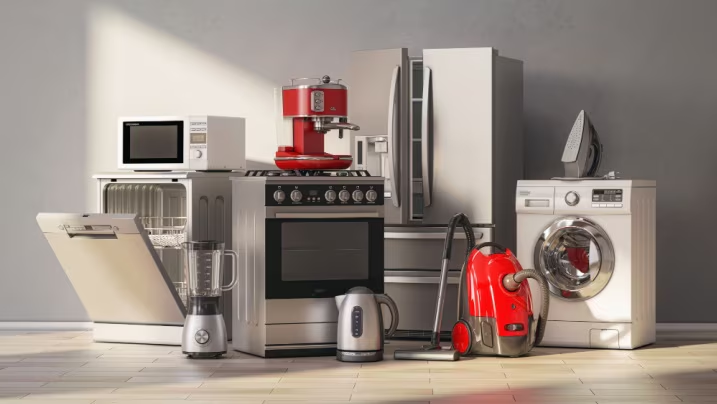
Purchasing major home appliances is one of the most significant financial investments a homeowner will make outside of the property itself. Refrigerators, washing machines, dishwashers, and ranges are the silent workhorses of the modern household. They run continuously, consume substantial amounts of water and electricity, and directly impact your daily quality of life.
However, walking into an appliance showroom or browsing an e-commerce platform can be an overwhelming experience. Consumers face a dizzying array of smart features, sleek finishes, and varied price points. It is easy to be enticed by a hyper-modern touch screen or an attractive exterior color, only to discover later that the underlying components are prone to premature failure. Securing true, long-term value requires looking past marketing gimmicks and evaluating appliances through a lens of structural engineering, energy efficiency, and lifetime repairability.
Part 1: The True Cost of Ownership
When shopping for a new appliance, most consumers focus almost entirely on the upfront purchase price. This is a critical financial mistake. The initial cost of an appliance represents only a fraction of its total lifetime expense. To calculate long-term value, you must account for operational costs, maintenance requirements, and the expected lifespan of the machine.
Energy and Resource Consumption
An appliance that appears to be a bargain on the sales floor can quickly become a financial liability if it inefficiently consumes utilities. In the United States, major appliances must feature an Energy Guide label. This yellow tag provides an estimated annual operating cost based on national average utility rates and displays the machine’s annual energy consumption in kilowatt-hours. Choosing models that carry the official Energy Star certification ensures the unit meets strict efficiency criteria set by the Environmental Protection Agency, saving thousands of dollars in utility bills over the lifetime of the machine.
Lifespan Discrepancies by Category
The baseline lifespans of modern appliances have shifted considerably over the past few decades due to the widespread integration of computerized components. On average, you can expect the following durability windows from well-maintained units:
-
Refrigerators: Eleven to fourteen years.
-
Washing Machines and Dryers: Ten to twelve years.
-
Dishwashers: Eight to ten years.
-
Gas Ranges and Ovens: Fifteen to eighteen years.
Understanding these lifespans helps you contextualize whether a premium price tag is justified. If a premium brand costs double the price of a standard model but only lasts the same number of years, the value proposition relies entirely on its specific features rather than its durability.
Part 2: Feature Creep and the Smart Appliance Trap
One of the biggest drivers of rising appliance costs is the introduction of smart technology and internet connectivity. While the idea of a refrigerator that tracks your grocery inventory or an oven you can preheat via a smartphone application sounds convenient, these features often actively detract from long-term value.
The Vulnerability of Complex Electronics
The mechanical components of basic appliances, such as compressors, heating elements, and electric motors, are highly refined technologies that can reliably operate for decades. However, integrating delicate digital circuit boards, touch screens, and wireless sensors introduces severe points of failure. Appliances operate in harsh environments characterized by extreme heat, heavy vibration, and high humidity. Over time, these conditions degrade electronic solder joints and computer chips far faster than heavy-duty mechanical parts.
Software Obsolescence
When you buy a traditional appliance, its functionality remains constant until a mechanical part wears out. When you buy a smart appliance, you become dependent on the manufacturer’s software ecosystem. If the manufacturer decides to stop updating the mobile application or completely shuts down the cloud servers supporting the appliance five years down the road, your high-tech machine can instantly lose its smart capabilities, rendering a premium investment obsolete.
Part 3: Selecting Durable Configurations Across Major Categories
To maximize the physical lifespan of your purchase, look for specific mechanical configurations that have proven to be inherently more reliable and easier to service.
Refrigerators: Prioritize Simplification
Refrigerators operate twenty-four hours a day, making them highly susceptible to wear and tear.
-
Avoid Through-The-Door Ice Dispensers: Industry repair data consistently reveals that built-in ice and water dispensers located on the exterior of the freezer door are the single most common cause of refrigerator repair calls. The complex mechanisms required to route ice through a warm refrigerator door frequently jam, leak, or suffer from electrical failures. Opting for an internal ice maker located entirely within the freezer compartment dramatically reduces these risks.
-
Compressor Types: Look for models featuring digital inverter compressors. Unlike traditional compressors that constantly switch completely on and off at full blast, digital inverters run continuously at variable speeds, reducing mechanical stress and lowering energy consumption.
Laundry Appliances: Mechanical Simplicity Wins
The debate between top-load and front-load washing machines often comes down to personal preference, but their mechanical designs offer differing levels of durability.
-
Commercial-Grade Top-Loaders: Traditional top-loading washing machines that utilize heavy-duty mechanical transmissions and steel drive shafts generally outlast complex front-loading models. They are less prone to bearing failures and do not suffer from the mold and mildew issues that frequently plague the rubber door seals of front-loading machines.
-
Direct Drive Motors: Whether you choose a top or front loader, seek out models with direct-drive motor configurations. These systems connect the motor directly to the wash drum without utilizing rubber belts or pulleys, eliminating common parts that stretch, slip, and break over time.
Dishwashers: Focus on Interior Construction
A dishwasher must withstand harsh detergents, high-temperature water, and constant moisture without degrading.
-
Stainless Steel Tubs: Avoid budget models that feature plastic interior tubs. Stainless steel tubs resist staining, do not absorb odors, retain heat much better to improve drying efficiency, and can withstand higher water temperatures that are necessary for proper sanitization.
-
Filter Systems: Look for dishwashers with easily accessible, manual-clean mesh filters rather than built-in hard food disposers. While manual filters require you to rinse them out occasionally, they lack the noisy, prone-to-jamming grinding blades found in mechanical disposal units.
Part 4: Warranty Realities and Repair Infrastructure
The value of an appliance is closely tied to how easily it can be fixed when something inevitably goes wrong. A long warranty means very little if local technicians cannot source the parts required to complete the repair.
Navigating Warranty Coverage
Standard manufacturer warranties typically cover parts and labor for exactly one year from the date of purchase. Some premium brands offer extended component-specific warranties, such as a ten-year warranty on a washing machine motor or a refrigerator compressor. Be sure to read the fine print; these extended warranties often cover only the cost of the physical part itself, leaving you responsible for paying expensive hourly labor rates to a certified technician.
Availability of Local Service
Before finalizing a purchase from an exotic or ultra-luxury appliance brand, contact independent appliance repair businesses in your immediate area. Ask them which brands they refuse to service. Many boutique or foreign manufacturers do not maintain robust parts distribution networks in North America. This can result in you waiting weeks or months for a replacement component to ship across the ocean, leaving your household without a functioning appliance in the meantime. Choosing brands with ubiquitous domestic supply chains guarantees faster, cheaper repairs.
Frequently Asked Questions
What are the mechanical differences between a gas range and an induction cooktop regarding lifespan?
Gas ranges are mechanically simplistic, relying on basic valves, spark igniters, and metal pipes to function, which allows them to easily last fifteen to twenty years with minimal maintenance. Induction cooktops utilize powerful electromagnetic coils controlled by complex electronic circuit boards beneath a glass surface. While induction offers superior energy efficiency and safety, the heavy reliance on sophisticated circuitry means they have a shorter average lifespan of eight to ten years and are significantly more expensive to repair if a board fails.
How does hard water affect the long-term value of major home appliances?
Hard water contains high concentrations of dissolved minerals like calcium and magnesium. When heated inside an appliance, these minerals crystallize and form scale buildup on heating elements, inside water valves, and throughout internal plumbing lines. This buildup forces dishwashers and washing machines to run hotter and longer to achieve the same results, accelerating mechanical wear and reducing energy efficiency. If your home has hard water, investing in a whole-house water softener is essential to preserve the lifespan of your appliances.
Is it financially worth it to purchase extended store warranties on major appliances?
Statistically, third-party extended warranties are rarely worth the upfront cost. Modern consumer data shows that the price of the warranty often approaches or exceeds the cost of a standard repair. Most mechanical defects caused by manufacturing errors manifest within the first year of ownership while the original factory warranty is still active. Instead of purchasing an extended warranty, a smarter financial strategy is to deposit that same money into a dedicated household emergency fund to cover repairs as they arise naturally.
Why do some modern washing machines take significantly longer to complete a cycle than older models?
Older washing machines utilized massive volumes of water to quickly saturate and agitate clothing, completing a cycle in thirty minutes. Modern washers are bound by strict federal environmental regulations regarding water consumption. To clean clothes thoroughly using up to seventy percent less water, modern machines must rely on extended tumbling and soaking periods. The longer cycle time is a deliberate engineering trade-off required to achieve high energy and water efficiency metrics.
What is the significance of an appliance being labeled as commercial residential?
Commercial residential appliances are designed for home use but incorporate the heavy-duty materials found in industrial laundromats or restaurant kitchens. They frequently feature thicker gauge stainless steel, heavier support springs, all-metal gearboxes, and commercial-grade motors. While these units carry a much higher initial purchase price and lack trendy digital features, their immense durability and ease of mechanical repair make them exceptional long-term investments for large families who heavily utilize their machines.
How often should a homeowner perform maintenance on a refrigerator to maximize its lifespan?
To keep a refrigerator running efficiently, you should clean the condenser coils at least twice a year. These coils, located either at the bottom behind a base grille or at the back of the unit, dissipate heat from inside the machine. Over time, they accumulate dust, pet hair, and debris, forcing the compressor to work twice as hard to keep food cold, which leads to premature compressor failure. Vacuuming these coils regularly maintains optimal heat transfer and significantly extends the life of the cooling system.